
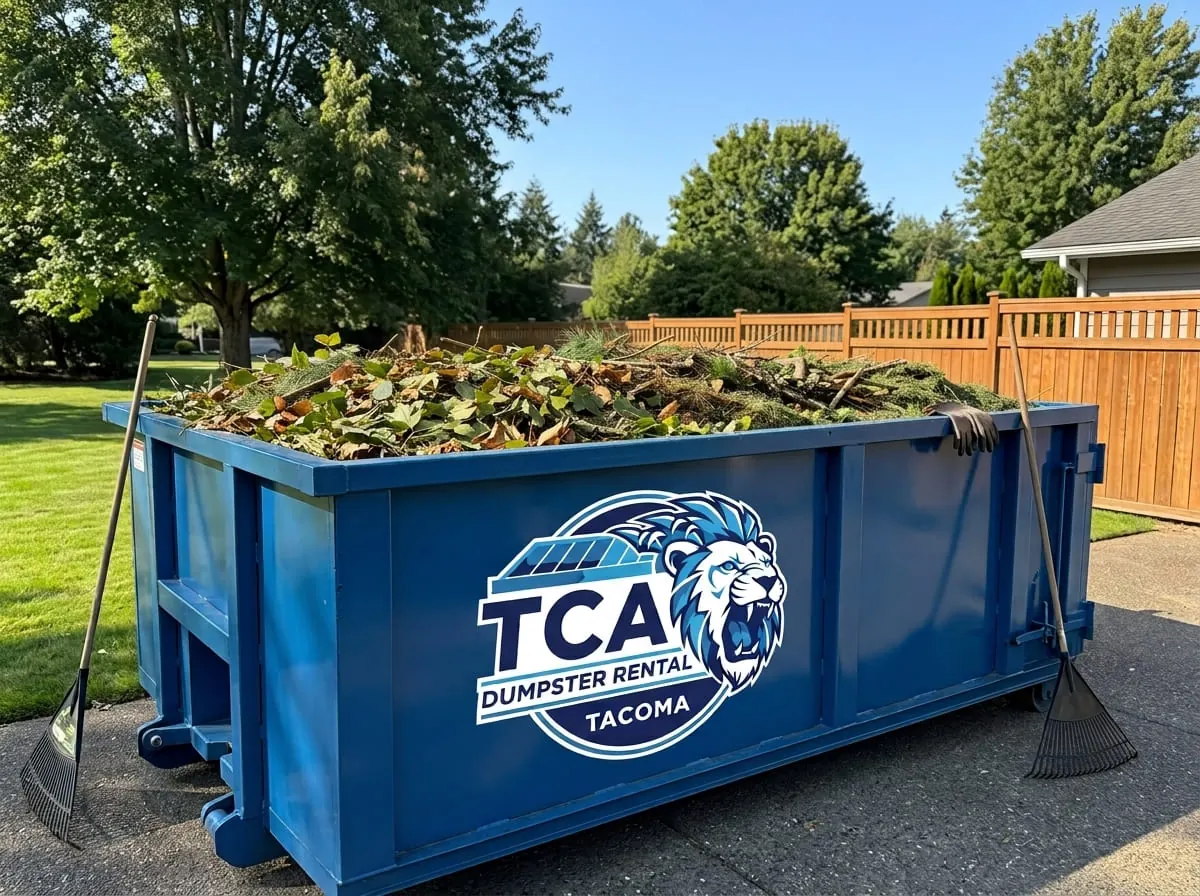
Yard waste
Yard Waste & Green Debris Removal in Tacoma, WA
Containers for blackberry, ivy, laurel, hedge removal and storm debris across Tacoma and Pierce County. Clean green waste gets composted, not buried — and we will tell you honestly what the wet season does to the weight.
Himalayan blackberry is the reason half these calls happen. It is a Washington-designated noxious weed, the canes run fifteen feet, and the root crowns regrow from any fragment left behind. Cut a thicket back and you find out what has been living in it: old chain link, a mattress frame, a water heater, forty years of fence line. Pulling it properly makes a volume of debris that surprises everyone.
Then there is the rest of it. English ivy climbing thirty feet up a Douglas fir or welded to Craftsman siding, a laurel hedge that has become a wall, arborvitae taken out to open a driveway, Scotch broom, bamboo somebody planted in 1998, and the moss and thatch that come off a Puget Sound lawn in barrow loads every spring. Add a winter storm and the limb drop that follows.
Green waste is where the rain bites hardest. Fresh cut vegetation is mostly water to begin with, and an uncovered container through a Tacoma November takes on plenty more. Keep the load clean — no soil, no rock, no plastic pots, no fencing — and it gets composted rather than landfilled. Throw the old fence panels in and the whole load becomes mixed waste. Read our note on blackberry clearing first.
Clearing Jobs Around the South Sound
Blackberry thicket clearing
The big one. Canes, crowns and everything the thicket was hiding. Pile the crowns separately so fragments do not get spread across the site when you rake it out.
English ivy removal
Ivy pulled off Douglas fir trunks and off Craftsman siding comes away in mats with bark, nails and paint chips in it. Heavy, tangled and slow to load.
Laurel and arborvitae hedge
Taking out a mature hedge produces more material than any homeowner predicts. A sixty-foot laurel run can fill a 20 yard by itself once the trunks come out.
Storm limb drop
After a South Sound windstorm the calls come in for days. Cut limbs to lengths that lie flat in the box; long branches waste half the container in air.
Moss and dethatching
A spring dethatch on a Puget Sound lawn produces an astonishing volume of wet thatch and moss. It is heavy for what it is, so keep it in a smaller box.
Scotch broom and bamboo
Both regrow from whatever you leave. Broom pulls best from wet ground with a weed wrench; running bamboo needs the rhizomes dug, and those come up with soil attached.
Overgrown lot reclaim
Rental turnovers, estate properties and acreage in Graham that has gone feral. Usually two containers across two weekends rather than one heroic push in a day.
Tree removal debris
If a service is dropping a fir or a maple, we can stage a container for the brush and small wood. Big rounds are a separate conversation — call the office first.
Green Waste Fills Faster Than You Think
Brush is all air until you compact it, and then it is all water. For a typical Tacoma lot — a hedge section, a season of pruning, a modest blackberry patch — a 15 yard is the sensible starting point. A full corner-lot clearing, a long laurel run or a serious thicket goes in a 20 yard. Cut everything short before it goes in and stomp it down as you load; you will fit close to twice as much. What changes the math is soil. The moment you are pulling root balls and sod with dirt attached, that material moves to a heavy debris box instead.
15 Yard Dumpster
Single-room remodels, roof tear-offs to about 20 squares, garage cleanouts.
View this size →20yd³20 Yard Dumpster
Kitchen guts, basement finishes, multi-room renovations, large cleanouts.
View this size →Keep It Clean and Keep It Covered
Two rules make green waste easy. First, keep it clean: no fence panels, no plastic pots, no landscape fabric, no rock, no bagged soil. Clean loads are composted; contaminated ones are landfilled and handled as mixed waste. Second, cover it. From October to May an open container gathers rain in every leaf and every hollow cane, and vegetation absorbs all of it. We leave a tarp and we would much rather you use it. On placement, we set on protection boards every time, and on a soft spring lawn or a wet gravel drive we will talk you out of a spot that is going to sink.
Not sure this is the right service? Describe the job on the phone and we will point you at the right container even if it is a different service page. Call (253) 328-9630.
Get a flat quote
Two minutes on the phone gets you a size, a price and a delivery slot. No forms.
(253) 328-9630Recommended sizes
Related services
How it works
Yard Waste & Green Debris in four steps
- 1
Call us
Tell us the project, your address and when you want it. Two minutes on the phone and you have a flat price.
- 2
We deliver
Our driver walks the drop, lays protection boards and sets the container exactly where you want it.
- 3
You load it
Take your time within your rental window. Keep it level with the top rail and we handle the rest.
- 4
We haul it
Call or text when you are done. We pull it, sort what can be recovered and dispose of the rest properly.
Yard Waste & Green Debris FAQs
Can I put dirt in with my yard waste?
Small amounts shaken off roots are fine and unavoidable. Root balls, sod and shoveled soil are not: they turn a compostable load into a heavy mixed load, and they are the most common reason a green waste job goes sideways. Wet Puget Sound soil is close to the heaviest material we haul. Put it in a 10 yard heavy debris box and keep the brush clean.
Will blackberry grow back after clearing?
Almost certainly, from the root crowns. Cutting the canes buys you a season; digging the crowns out is what actually kills it, and even then expect regrowth from fragments for a year or two. Clear, dig, then keep after the new shoots while they are small. The state noxious weed board publishes solid guidance at nwcb.wa.gov if you want the detail.
When is the best time of year to clear?
Late summer and early fall, if you have the choice. The ground is workable, the vegetation weighs less, and the container is not collecting rain all week. That said, most of this work happens in spring, when everyone looks at the yard for the first time in months. Clearing in the wet season, tarp the box daily and expect the load to weigh more than the same brush would in August.
Do you take stumps?
Small stumps, yes, provided the soil is knocked off them. Large stumps with root balls attached are a different animal — they are mostly dirt by weight and they do not break down at a compost facility. Call and describe the diameter before you dig one out. Sometimes the right answer is a grinder and a wheelbarrow rather than a container at all.
Is the green waste really composted?
Clean loads are, yes. Yard debris around Pierce County goes to composting rather than into the LRI landfill at Graham, which is a better outcome and keeps disposal simpler for everyone. The catch is contamination: one roll of chicken wire or a stack of pressure-treated fence boards reclassifies the whole load. If your job produces both, order a second container for the debris.
More services
Other things we haul
Residential Dumpster Rental
Driveway, alley or street placement for cleanouts, remodels and basement projects.
Learn more →Commercial Dumpster Rental
Scheduled and on-call containers for retail, restaurants, offices and property managers.
Learn more →Construction Dumpster Rental
Jobsite roll-offs and next-day swap-outs for builders, remodelers and GCs.
Learn more →Roofing Dumpster Rental
Weight-rated cans for composition tear-offs, cedar shake and wet moss-laden debris.
Learn more →Roll-Off Dumpster Rental
10, 15, 20, 30 and 40 yard roll-offs delivered across Tacoma and Pierce County.
Learn more →Same-Day Dumpster Rental
Call before the cut-off and we can usually get a container to you this afternoon.
Learn more →Junk Removal Dumpsters
Clear a basement, crawlspace, garage or storage unit on your own schedule.
Learn more →Estate Cleanout Dumpsters
Discreet, patient container service for families clearing a lifelong home.
Learn more →Demolition Debris Removal
Containers and fast swaps for strip-outs, decks, sheds, patios and garages.
Learn more →Concrete & Heavy Debris
Dedicated heavy cans for concrete, brick, tile, sod and wet Puget Sound soil.
Learn more →Where we deliver
Yard Waste & Green Debris across Pierce County and the South Puget Sound
Same service, same flat rates, every town below. Pick yours for local placement and permit notes.
Talk to a real person
Need yard waste & green debris in Tacoma?
Tell us what you are clearing out and we will tell you the right size and the flat price to put it in your driveway. No forms, no waiting on an email — just call and we will sort it out in a couple of minutes.
Serving Tacoma, Pierce County and the South Puget Sound · Mon–Fri 6:30am–6pm, Sat 7am–3pm