Heavy debris
Concrete & Heavy Debris Dumpsters in Tacoma, WA
Ten yard containers for concrete, brick, block, asphalt, sod, soil and rock across Tacoma and Pierce County. Clean loads get crushed into aggregate instead of buried. Flat-rate pricing, protection boards standard.
Concrete is the one material where the smallest container is almost always the right one. A 10 yard box holds more broken slab than most people can load in a weekend, and it reaches its legal road weight long before it looks full. Watching a customer's face when we explain that is a regular part of the job. It is physics, not policy.
Keep the load clean and it gets a better ending. Clean concrete, brick and block are crushed into aggregate around here rather than buried. Clean means no rebar tangles you cannot cut, no wood, no plastic sheeting, no dirt clods riding along, and no trash tossed on top at the end of the day. One bag of household garbage turns a clean concrete load into mixed waste.
Sod and soil catch people out worse than concrete does. Sod comes up with two or three inches of dirt attached, and a pallet of it is heavier than it looks even dry — and nothing in Tacoma is dry from October to May. Saturated Puget Sound soil is close to the heaviest thing you can put in a container. Half a 10 yard is often the whole load.
Heavy Material We Haul in Pierce County
Driveway and slab removal
Broken-out driveway, patio slab or garage floor. Break it into pieces two people can carry, load it flat and low, and keep any rebar cut back short.
Sidewalk and steps
Old Tacoma sidewalk panels and the concrete stairs climbing to a Craftsman porch. Steep bluff lots mean a lot of steps, and every one of them is dense.
Brick and block
Chimney takedowns, retaining wall block, old foundation brick. Clean masonry recycles the same way concrete does, so keep mortar rubble and household trash out of it.
Sod and turf removal
Lawn replacement is popular here and sod is deceptively heavy with soil attached. Strip it in dry weather if you have the choice; a wet pallet weighs half again as much.
Excavated soil
Footings, drainage trenches, French drains and regrading. Wet clay soil is the heaviest common load we haul, and it belongs in a 10 yard no matter the project size.
Landscape rock and gravel
River rock beds, decorative gravel and old drain rock. It loads fast, it settles dense, and a small-looking pile fills the weight allowance more quickly than you expect.
Asphalt removal
Driveway asphalt from 1960s and 70s properties south through Parkland and Spanaway. Keep it separate from concrete where you can — it recycles down a different path.
Tile, mortar and stone
Mortar bed under old bathroom tile, flagstone patios and stone veneer are all inert and all heavy. They belong with the concrete, not in the mixed demo box.
Why Ten Yards Is the Answer
There is no clever workaround here. Concrete, brick, block, asphalt, sod, soil, rock and tile go in a 10 yard container, and on a large job you take more than one rather than a bigger box. A 10 yard is short and low-sided, which matters a great deal when you are wheelbarrowing material that heavy by hand. If the job also produces framing, forms, fencing or general trash, order a 20 yard alongside it and keep the two streams apart. Two right-sized boxes cause far less trouble than one overweight load a driver has to leave sitting.
10 Yard Dumpster
Concrete, flagstone, landscape rock, brick, dirt, tile and small heavy-debris jobs.
View this size →15yd³15 Yard Dumpster
Single-room remodels, roof tear-offs to about 20 squares, garage cleanouts.
View this size →Loading Heavy Material Without Wrecking Your Drive
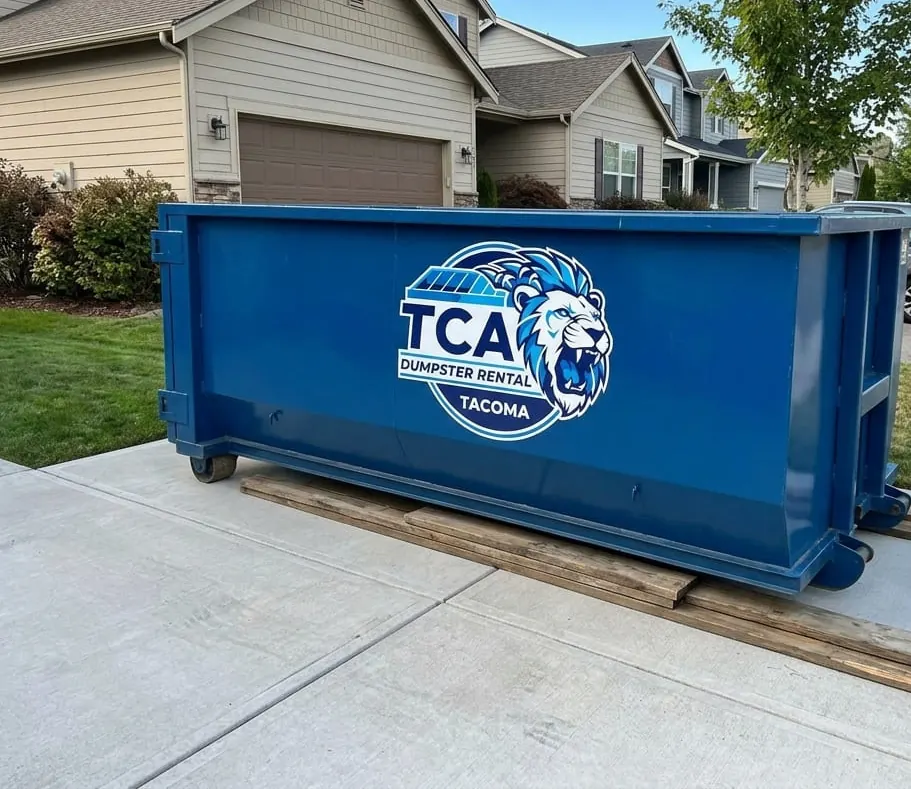
A concrete box is the hardest thing we put on a residential driveway, so protection boards are never optional on these jobs and we bring extra plywood for pavers, sealcoat and stamped concrete. Load evenly — flat pieces laid across the floor rather than piled at one end — because a load stacked at the back makes the container hard to pull and hard on the surface underneath. Never load above the top rail; heavy material has to sit level for legal transport. And through the wet months, keep a tarp over soil and sod, since rain adds weight to material that was already at the limit.
Not sure this is the right service? Describe the job on the phone and we will point you at the right container even if it is a different service page. Call (253) 328-9630.
Get a flat quote
Two minutes on the phone gets you a size, a price and a delivery slot. No forms.
(253) 328-9630Recommended sizes
Related services
How it works
Concrete & Heavy Debris in four steps
- 1
Call us
Tell us the project, your address and when you want it. Two minutes on the phone and you have a flat price.
- 2
We deliver
Our driver walks the drop, lays protection boards and sets the container exactly where you want it.
- 3
You load it
Take your time within your rental window. Keep it level with the top rail and we handle the rest.
- 4
We haul it
Call or text when you are done. We pull it, sort what can be recovered and dispose of the rest properly.
Concrete & Heavy Debris FAQs
Why can I not put concrete in a 20 yard?
You can put it in. Nobody can legally haul it out. A 20 yard filled with broken slab sits far over the road weight limit for the truck, and the driver would have to unload part of it by hand before leaving your street. A 10 yard is engineered for that density. This is not a pricing tactic — it is the axle weight rules every hauler in Washington works under.
How much concrete actually fits?
As a rough field rule, a 10 yard box takes something in the range of a two-car driveway's worth of four-inch slab, and less when the slab is thicker or has rebar and mesh through it. We would rather walk the job with you on the phone. Give us the square footage and the depth, and we will tell you whether it is one container or two before you start breaking.
Does clean concrete really get recycled?
It does. Clean concrete around the South Sound is crushed and reused as aggregate for road base and fill instead of going into the LRI landfill at Graham. That is why we push so hard on keeping the load clean: no wood, no plastic, no dirt, no trash. Rebar is workable when it is cut back flush, but long tangles hanging over the rail have to go.
Can I mix soil and concrete in one box?
Better not to. Both are inert and both are heavy, but they go to different places, and a mixed load usually gets handled as the lesser of the two. If you have a small amount of one and a lot of the other, call and describe it. Sometimes the answer is that it is fine, sometimes it is a second container, and it is a short conversation either way.
Will you deliver on gravel and dirt?
Often, with conditions. We serve a lot of acreage out toward Graham and Orting with long gravel drives, and a loaded heavy box will rut soft ground badly from October through May. In the dry months it is usually straightforward. Tell us about the drive, the grade and any septic drainfield when you book, so we can pick a spot that will still be there afterwards.
More services
Other things we haul
Residential Dumpster Rental
Driveway, alley or street placement for cleanouts, remodels and basement projects.
Learn more →Commercial Dumpster Rental
Scheduled and on-call containers for retail, restaurants, offices and property managers.
Learn more →Construction Dumpster Rental
Jobsite roll-offs and next-day swap-outs for builders, remodelers and GCs.
Learn more →Roofing Dumpster Rental
Weight-rated cans for composition tear-offs, cedar shake and wet moss-laden debris.
Learn more →Roll-Off Dumpster Rental
10, 15, 20, 30 and 40 yard roll-offs delivered across Tacoma and Pierce County.
Learn more →Same-Day Dumpster Rental
Call before the cut-off and we can usually get a container to you this afternoon.
Learn more →Junk Removal Dumpsters
Clear a basement, crawlspace, garage or storage unit on your own schedule.
Learn more →Estate Cleanout Dumpsters
Discreet, patient container service for families clearing a lifelong home.
Learn more →Demolition Debris Removal
Containers and fast swaps for strip-outs, decks, sheds, patios and garages.
Learn more →Yard Waste & Green Debris
Blackberry, ivy, laurel, brush, limbs and storm debris hauled to be composted.
Learn more →Where we deliver
Concrete & Heavy Debris across Pierce County and the South Puget Sound
Same service, same flat rates, every town below. Pick yours for local placement and permit notes.
Talk to a real person
Need concrete & heavy debris in Tacoma?
Tell us what you are clearing out and we will tell you the right size and the flat price to put it in your driveway. No forms, no waiting on an email — just call and we will sort it out in a couple of minutes.
Serving Tacoma, Pierce County and the South Puget Sound · Mon–Fri 6:30am–6pm, Sat 7am–3pm