
Dumpster Sizes
What Size Dumpster Do I Need? A Tacoma Homeowner's Sizing Guide.
Sizing a roll-off is really two questions: how much room your debris takes up, and how much it weighs. Here is how we size Tacoma jobs after thirteen years.
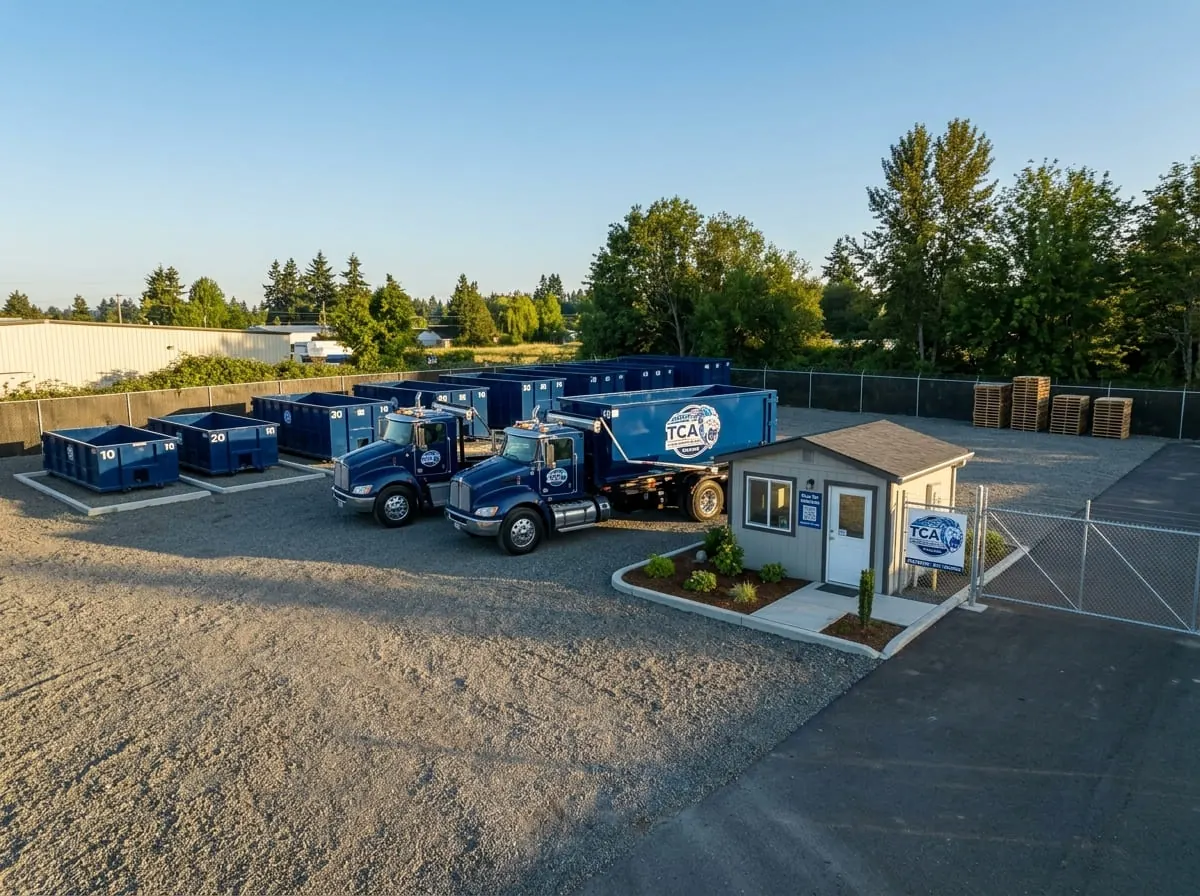
I have been setting roll-off boxes in Pierce County since 2012, and the question I field more than any other is some version of "what size do I need?" The honest answer is that size is two questions wearing one coat: how much room does your debris take up, and how much does it weigh. Get the first wrong and you pay for a second haul. Get the second wrong and you pay overage on a box you could not even fill. In this corner of the country, the second mistake is the expensive one.
Here is how we actually size jobs from our yard on Stewart Street in the Dome District, a few blocks off the tideflats.
What a cubic yard actually looks like
A cubic yard is a cube three feet on a side, twenty-seven cubic feet. That means nothing until you translate it into things you have loaded by hand.
- One cubic yard is about five 42-gallon contractor bags packed the way a normal person packs them, not the way a framer stomps them down.
- One cubic yard is roughly half a level load in a full-size eight-foot pickup bed. A bed filled flush to the rails holds about two to two and a half yards.
- So a 10 yard box is four honest pickup loads, or fifty contractor bags. A 20 yard is eight pickup loads. A 30 yard is twelve. A 40 is sixteen.
Run that math before you call. If you looked at your garage and thought "three truckloads," you do not need a 30 yard. Every size we stock is laid out side by side on our dumpster sizes page.
Weight versus volume: the thing people get wrong
Every roll-off carries a tonnage allowance baked into the flat rate — roughly two tons on a 10, two and a half on a 15, three on a 20, four on the 30 and 40. Past that, the transfer station charges by the ton and so do we.
Here is what trips people up: volume and weight run out at completely different rates depending on what you are throwing away. A 30 yard packed to the rails with couches, mattresses, cardboard and cabinet boxes might weigh 1,800 pounds. That same 30 filled one-third of the way with wet sod and broken patio concrete weighs eleven tons, and the truck cannot legally leave your street.
Bulky-light debris runs out of room first. Dense debris runs out of weight first, long before it looks full. For what tonnage does to a bill, see our Tacoma dumpster rental cost guide.
Footprints, and whether the thing fits your driveway
Rough outside dimensions, all eight feet wide: the 10 yard runs 12 feet long and 3.5 feet tall; the 15 is 16 feet long and 4 feet tall; the 20, 30 and 40 all share a 22-foot footprint and differ only in wall height, at roughly 4.5, 6 and 8 feet.
That last point matters. If a 20 fits your driveway, so does a 30 — the constraint is the ground, not the box. But the truck needs more than box length. Figure about 60 feet of straight approach to roll a can off the rails, 12 feet of width, and 23 feet of overhead clearance with the hoist up. Power drops, low maple limbs and carport eaves have killed more deliveries than tight driveways ever have.
The old grid: North Slope, Hilltop, Proctor
These are the neighborhoods where size gets decided by geometry instead of debris. Lots platted before 1920 came with driveways built for a Model A — 8 or 9 feet wide, garage sitting flush at the back of the lot, no room to place a box on the property at all. Two things usually save the job: the rear alley, which many of these blocks still have, or the street.
Alleys work when they are clear and paved, but I will not commit to one sight unseen; sagging utility lines and neighbors' parked cars decide that. Street placement means a city right-of-way permit, so read our Tacoma dumpster permit guide before you plan around it. On these blocks a 15 yard is frequently the largest thing that makes sense, even for a job that would call for a 20 elsewhere.
Steep bluff streets
North End streets falling toward Ruston Way, the runs above Schuster Parkway, parts of the Salmon Beach approach — grade is the issue. A loaded roll-off does not want to sit crossways on a steep driveway, and a truck cannot safely winch a heavy can uphill on a wet slope in February. On serious grade we go smaller and swap more often. A 10 turned twice beats a 30 we cannot retrieve.
The rambler belt, south and west
Once you reach the 1950s through 1970s stock — University Place, Fircrest, Lakewood, South Tacoma, Parkland, Summit — driveways widen out. Two-car aprons, real setbacks, straight approaches. This is where a 30 or 40 drops without drama. Whatever the surface, put something under the rails; fresh asphalt in August and thirty-year-old slab in January both mark up. We bring plywood and use it, and there is more in our note on protecting your driveway during delivery.
Size by project
| Project | Typical size | Why |
|---|---|---|
| Single bathroom gut | 10 yard | Tile, tub, vanity and backer board are heavy and low-volume. Weight caps you before space does. |
| Kitchen remodel, cabinets and flooring out | 15 yard | Cabinet boxes eat volume. Add a countertop and you want room, not tonnage. |
| One room stripped to studs | 10-15 yard | Lath and plaster in a pre-war house doubles the weight versus modern drywall. Size down. |
| Whole-house cleanout, 3 bedroom | 20-30 yard | Furniture and household goods are bulky and light. Volume is the binding constraint. |
| Roof tear-off, up to 20 squares | 10-20 yard | Composition runs 250-350 lb per square per layer. Two layers on 20 squares is over five tons. |
| Deck demo, 300-400 sq ft | 15-20 yard | Old pressure-treated joists hold water and stack badly. Cut to four-foot lengths. |
| Two-car garage cleanout | 15-20 yard | Mostly bulky-light, but paint, tires and old concrete mix change the math fast. |
| Crawlspace: barrier, insulation, rodent debris | 10 yard | Insulation weighs nothing, but wet soil and old vapor barrier come out far heavier than expected. |
| Concrete, brick, sod, dirt | 10 yard only | Filled a third to half. One yard of concrete is about two tons on its own. |
The Pacific Northwest weight trap
This is the part of sizing specific to us, and the reason I have this conversation on the phone instead of letting people click a size online.
An open 20, 30 or 40 yard box has about 176 square feet of opening. One inch of rain falling straight into it is roughly 110 gallons of water — about 915 pounds. Nearly half a ton per inch, before anything absorbs a drop. A normal Tacoma November brings close to six inches. That is two and a half tons of rainwater in a box you loaded dry.
Absorption is worse than the direct catch. Carpet and pad that weighed 50 pounds per hundred square feet coming out of a bedroom can weigh triple that after a weekend of rain. Drywall turns to sponge and then to slurry in the bottom of the can. Soil and sod climb from roughly 2,000 pounds a yard dry toward 2,700 wet. I have watched a 20 yard sit comfortably inside its three-ton allowance on a Friday and cross five tons by Monday, because nobody covered it and it rained an ordinary Puget Sound weekend.
So: tarp the box. Every one of ours goes out with a cover for a reason. October through May, keep it on any time you are not actively loading, and weight the corners. Rainfall records for the region are published by the Washington Department of Ecology if you want to see how lopsided our wet season is.
Cedar shake and moss
Roofing gets underestimated here more than anywhere else. Composition shingle is predictable. Cedar shake is not. Dry shakes run 300 to 400 pounds a square; the same square off a north-facing Tacoma roof carrying twenty years of moss and trapped moisture can pass 600. Moss holds water like a sponge and does not give it up. Tearing off cedar, or comp with heavy growth, assume you are 40 to 60 percent heavier than the charts say and size down. Our roofing tear-off sizing guide goes square by square.
Heavy material goes in a 10 yard, whatever the job size
Concrete, asphalt, brick, block, rock, dirt, sod, roofing. All of it goes in a 10 yard, and the 10 yard does not get filled to the top. Half full is often the limit; with clean concrete, a third.
People push back constantly. "I have thirty yards of patio to remove, why bring a small can?" Because thirty yards of concrete is sixty tons, which is not a dumpster problem, it is a fifteen-truck problem. We solve it with repeat pulls on a small box. Clean rubble also routes to different facilities than mixed waste — see our heavy debris service and the disposal guidance from Pierce County.
The 40 yard is a volume box, not a big box
The 40 exists for one reason: bulky debris that weighs almost nothing per cubic foot. Cleanouts, cardboard and packaging, office furniture, insulation, siding, retail fixtures. On those jobs it is exactly right, and we run it hard for commercial accounts. It is the wrong answer for anything heavy. Eight-foot walls mean people keep loading long after the weight allowance is spent, and the box does not tell you to stop. If your debris list includes concrete, dirt, tile, plaster or roofing, the 40 is not a shortcut, it is a trap.
Size up, or take two hauls?
My rule: size up when the debris is light, take two hauls when the debris is heavy. The jump from a 20 to a 30 costs relatively little and buys ten yards of room — a good trade on a cleanout, a bad one on a demo, where you will hit tonnage in the 30 and pay overage on top of a higher base price.
Two other things push toward a swap. Steep or narrow placement, already covered. And staged jobs: most remodels produce heavy debris first and framing and finish material later, so a 10 for demo and a 20 for the rest beats one 30 doing both jobs badly. We run same-day delivery and next-day swaps, so staging is not the hassle people assume.
Level load and overfill
Debris cannot ride above the top rail. That is not company policy, it is load-securement law, and a heaped can gets refused at the gate or tarped off and re-picked at your expense. Load flat: long pieces on the bottom running lengthwise, heavy material spread across the floor instead of piled at the door end, voids filled as you go. A well-loaded 20 holds more than a careless 30.
Mattresses, appliances with refrigerant, tires, paint, batteries and anything containing asbestos are handled separately, and pre-1990 homes need a survey before demolition — start with our notes on what can go in a dumpster. Permits and right-of-way questions go through the City of Tacoma.
If you are still not sure, describe the job and we will size it. Thirteen years of pulling cans out of Tacoma driveways means we have almost certainly done your project before, and we would rather talk you into a smaller box than collect an overage. Call TCA Dumpster Rental Tacoma at (253) 328-9630 or reach us through our contact page — flat rate, licensed and insured, same-day and next-day delivery across Tacoma, Pierce County and the South Sound.
Questions this guide did not answer? Call (253) 328-9630. We would rather spend two minutes on the phone than have you order the wrong container.