Roofing
Moss, Rain and Roof Replacement in Tacoma: What It Costs You and When to Replace
Moss is the clock running on every shaded Tacoma roof. A 13-year roll-off operator on the signs you are past cleaning, why pressure washing kills roofs, cedar shake weights, and container sizing for wet tear-offs.
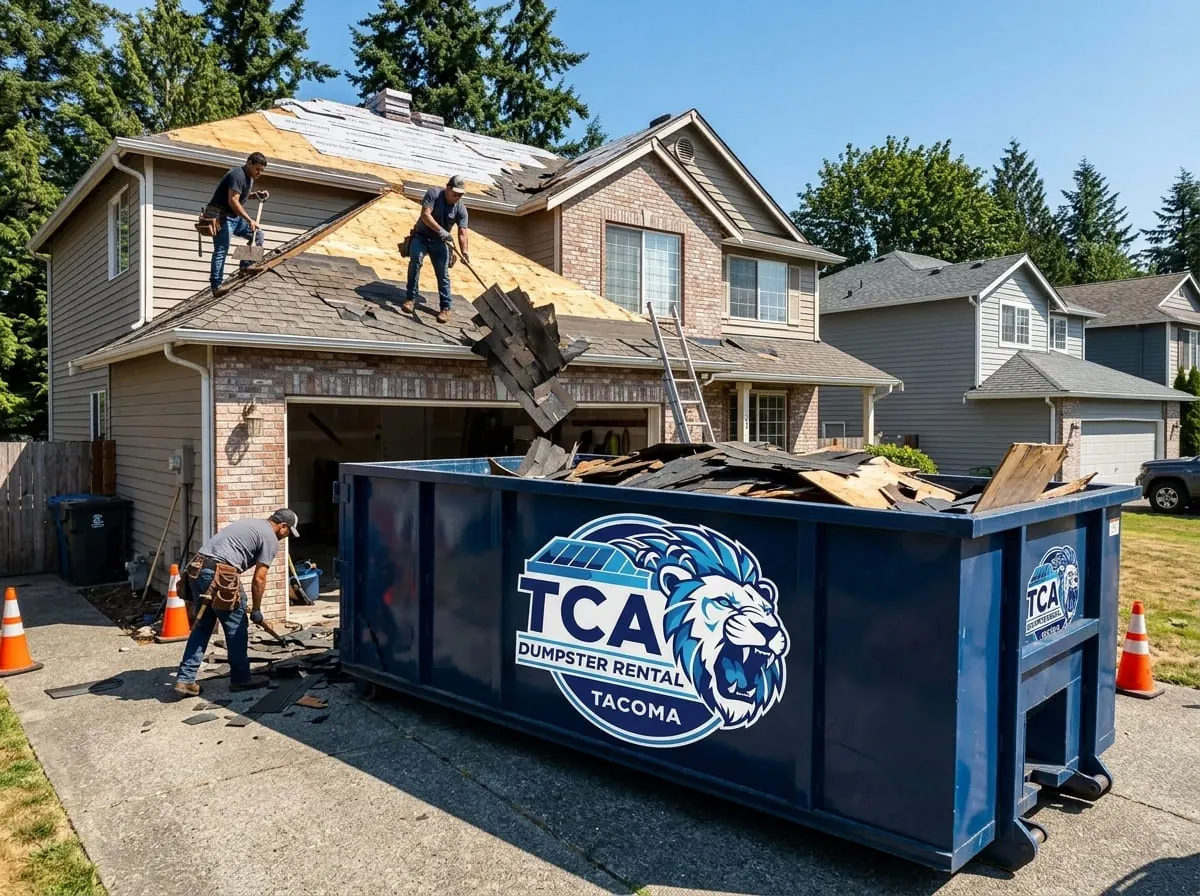
I have been pulling roofs out of Tacoma driveways since 2012, and the one thing that separates roofing here from roofing almost anywhere else is moss. A roof in Phoenix dies of ultraviolet light. A roof in Tacoma dies of a plant. If your house sits under Douglas fir or big-leaf maple on a north-facing slope in the North End, Fircrest, or up the hill in Gig Harbor, moss is the clock running on your roof, and it never stops, because we never get a freeze hard enough to kill it.
Moss Is a Structural Problem Here, Not a Cosmetic One
Homeowners look at green fuzz on a roof and file it next to dirty siding. Wrong mental model. Moss has no true roots, but it builds a dense mat that anchors into the gap at the butt edge of every shingle course, and as that mat thickens it physically lifts the tab off the course below. Once the tab is lifted, three things happen at once.
First, the mat holds water. A saturated moss pad the thickness of your thumb keeps the shingle under it wet for days after the rain stops, which from October through May here means permanently wet. Second, water wicks sideways and uphill under the lifted course, gets past the headlap, and reaches the felt and then the deck. Third, the wet-dry cycling and the mild acid the mat produces strip the ceramic granules off the asphalt. Granules are the roof's armor. Lose them and the mat goes brittle fast.
By the time you can see moss clearly from the street, water has usually been sitting against the deck at the north eaves and in the valleys for a couple of seasons. I have torn off plenty of roofs where the south slope had eight years left and the north slope had rotted sheathing in the bottom two courses.
The Signs It Has Gone Past Cleaning
There is a real line between a roof that needs treatment and a roof that needs a tear-off. Here is what I look for, and what a decent roofer tells you before he gives you a number:
- Curling or cupping tabs. Edges lifting up, or the center of the tab dishing. That is the mat drying out and shrinking. It does not reverse.
- Granules in the gutters. Scoop out the downspout elbow. A little grit is normal. A quarter inch of black sand in the trough means the roof is done.
- Moss growing under the shingle rather than on top of it. This is the big one. If the mat is coming out from beneath the course, the shingle is already lifted and the seal strip is broken.
- Soft or spongy decking. Any give underfoot when a roofer walks it, especially at the eaves or in a valley, means sheathing that has been wet long enough to delaminate.
- Daylight or staining in the attic. Go up with a flashlight on a dry day and look at the underside of the north slope. Dark tannin streaks, white fuzz, or pinholes of daylight at the nail line settle it.
Any two of those together and you are replacing, not cleaning. One of them on an otherwise sound roof under fifteen years old and you may have room to treat it.
Clean and Treat Versus Replace
Zinc or copper strips at the ridge work, and they are not marketing. Rain picks up metal ions running over the strip and carries them down the slope, and moss will not colonize in that runoff. On a roof with life left, a ridge strip plus treatment every couple of years is cheap insurance. Pair it with cutting back the maple and fir limbs shading that slope, because moss needs shade more than it needs water and we have no shortage of either. Gentle treatment means a zinc sulfate or potassium salt product applied dry and brushed off downhill with a soft broom weeks later. Not scrubbing. Not a ladder and a garden hose in December.
Now the warning, and I mean this one. Pressure washing destroys more roofs on the Puget Sound than moss does. A pressure washer blasts the granules off in seconds, drives water uphill under every course it touches, and breaks the factory seal strip on tabs that were still holding. I have hauled off roofs with eight or ten good years left that were killed in one afternoon by a soft-wash truck that was not actually soft. If someone quotes you a price to pressure wash a composition roof, that is a person you do not hire. The roof will look wonderful for a season and fail three years early.
Where the math flips: spending real money treating a roof that is already curling, shedding granules, and twenty years old buys two seasons at a quarter of what a new roof costs. Put that money in the tear-off. Our roofing tear-off size guide walks through the container end of it in more detail.
Cedar Shake Is a Different Animal
Plenty of older Tacoma and Gig Harbor houses still have cedar under whatever is on top. Cedar shake behaves nothing like composition, and it changes the container maths in three ways.
It is heavier per square than most composition. It is usually laid over skip sheathing, one-by boards with gaps rather than solid plywood, so once the shake is off the crew is often re-decking the whole roof and that plywood goes in the box too. And frequently somebody in the 1980s laid composition straight over the cedar instead of tearing it off. That one surprises people: you are not removing one roof, you are removing two, and volume roughly doubles while weight more than doubles, because saturated cedar is dense.
Cedar also bulks strangely. Shakes do not nest flat the way shingle tabs do, so a box full of cedar is full of air. You hit the fill line before the weight limit, the opposite of the composition problem.
Weight and Sizing: The Numbers That Actually Matter
A roofing square is 100 square feet. That is the unit every roofer quotes in, so learn it. A Tacoma rambler with a simple gable runs 18 to 22 squares. A two-story with dormers and a garage runs 32 to 40.
| Roof material | Approx. weight per square (100 sq ft) | Recommended container |
|---|---|---|
| 3-tab composition, single layer | 220–250 lbs | 15 yard up to ~25 squares |
| Architectural / laminated composition | 350–450 lbs | 20 yard up to ~25 squares |
| Two layers of composition | 500–700 lbs | 20 yard, plan a swap past 20 squares |
| Cedar shake, dry | 350–450 lbs | 20 yard (runs out of room before weight) |
| Cedar shake with composition over it | 700–900 lbs | 20 yard plus a second pull, nearly always |
| Skip sheathing / plywood re-deck | 150–250 lbs per square added | Budget it as extra volume, not extra weight |
| Wet, moss-laden tear-off (any of the above) | Add 25–40% | Drop one size and schedule a swap |
That last row is the Tacoma row and the one people ignore. Moss-laden debris torn off in November is soaked through, and the mat holds water like a sponge. I have weighed loads off identical houses in August and February with a forty percent spread between them.
This is why 15 and 20 yard boxes are the working sizes for roofing here, and why I will talk you out of a 30 yard or 40 for a tear-off. Roofing debris is dense and low-volume. A 30 or 40 loaded with wet composition will exceed legal transport weight for the truck long before the box looks full, and then it either cannot be hauled or it costs you overage. Two pulls on a 20 beats one illegal load on a 40 every time. If you are still deciding, this sizing walkthrough and our Tacoma cost breakdown cover the rest.
Pre-1980 Roofs: Get the Survey First
If the house was built before 1980, stop before anyone swings a shovel. Cement-asbestos roofing panels, asbestos-containing shingles, and asbestos in the felt underlayment were all normal here in that era. Washington requires a good-faith asbestos survey by an accredited inspector before renovation or demolition, and the Puget Sound Clean Air Agency is the authority for Pierce County. A notification is filed, waiting periods apply, and no landfill in the region will accept a load they believe is contaminated. We will not haul one either. Read the full walkthrough in our asbestos survey guide, and check what can and cannot go in the container before loading day. Worker protection rules under Washington L&I apply to the crew as well.
Placement on the Old Tacoma Grid
Our older neighborhoods were platted for narrower vehicles than a roll-off truck. On the Hilltop, in the Stadium District, and much of the North End you get short driveways, tight setbacks, cars parked both sides, and alleys behind the houses. An alley drop is often the better answer on a roofing job because it puts the box directly under the back slope, but alleys collect standing water and the surface is usually gravel over soft fill. In February that matters.
A few things I insist on. We plank under the wheels and rear rollers on any driveway, doubly so on asphalt in warm weather; see our notes on protecting a driveway during delivery. We do not set a loaded box on saturated lawn, because it sinks and leaves ruts you are re-sodding in spring. On the bluff streets above Ruston Way and the grades in the South End we chock and set square to the slope. And tarp the container between work days in the wet season. An open box collecting three days of rain on soaked shingles is weight you pay to haul and weight the truck has to legally carry. If the box goes in the street rather than on private property, you need a right-of-way permit from the City of Tacoma first.
Gutters, Skylights and the Rest of the Job
Do them now. Gutters are already coming off during a tear-off, the fascia is exposed, the staging is up, and the box is already in the driveway. Same with skylights, which fail on roughly the same schedule as the roof and which nobody wants to reflash later through new shingles. Added to an existing roofing job, both cost a fraction of a standalone call, and the debris rides along in a container you are already paying for.
Book Early for the Dry Window
Roofing in Pierce County happens between roughly July and September. That is not a preference, it is the only stretch where a crew can reliably open a deck and dry it in. Every roofer in the South Sound wants a container in the same eight weeks, and late July through mid-August is the crunch. Call in June and you get the day you want. Call the second week of August and you get what is left. Book the container when you sign the roofing contract, not the night before the crew shows up. We keep 15s and 20s staged for roofing through the season and hold slots for contractors on standing accounts.
TCA Dumpster Rental Tacoma has been running roll-offs out of 1820 Stewart Street since 2012. Flat-rate pricing, licensed and insured, and next-morning delivery for roofing crews so your tear-off day is not waiting on us. If you are a contractor, ask about a standing account with priority scheduling and consolidated billing across jobs. If you are a homeowner and you are not sure whether you are looking at a cleaning or a replacement, call and describe what you are seeing and we will tell you straight, including when the answer is that you do not need us yet. See our roofing dumpster service, check the areas we cover across Pierce County and the South Sound, or get in touch. Call Grant and the crew at (253) 328-9630.
Questions this guide did not answer? Call (253) 328-9630. We would rather spend two minutes on the phone than have you order the wrong container.