
Roofing
Roof Tear-Off Dumpster Sizing in Tacoma: Squares, Layers and Rain
A 13-year Tacoma roll-off operator on turning roofing squares into tonnage: pitch multipliers, weight by material, hidden layers, the rain factor, and why the 15 and 20 beat the 40.
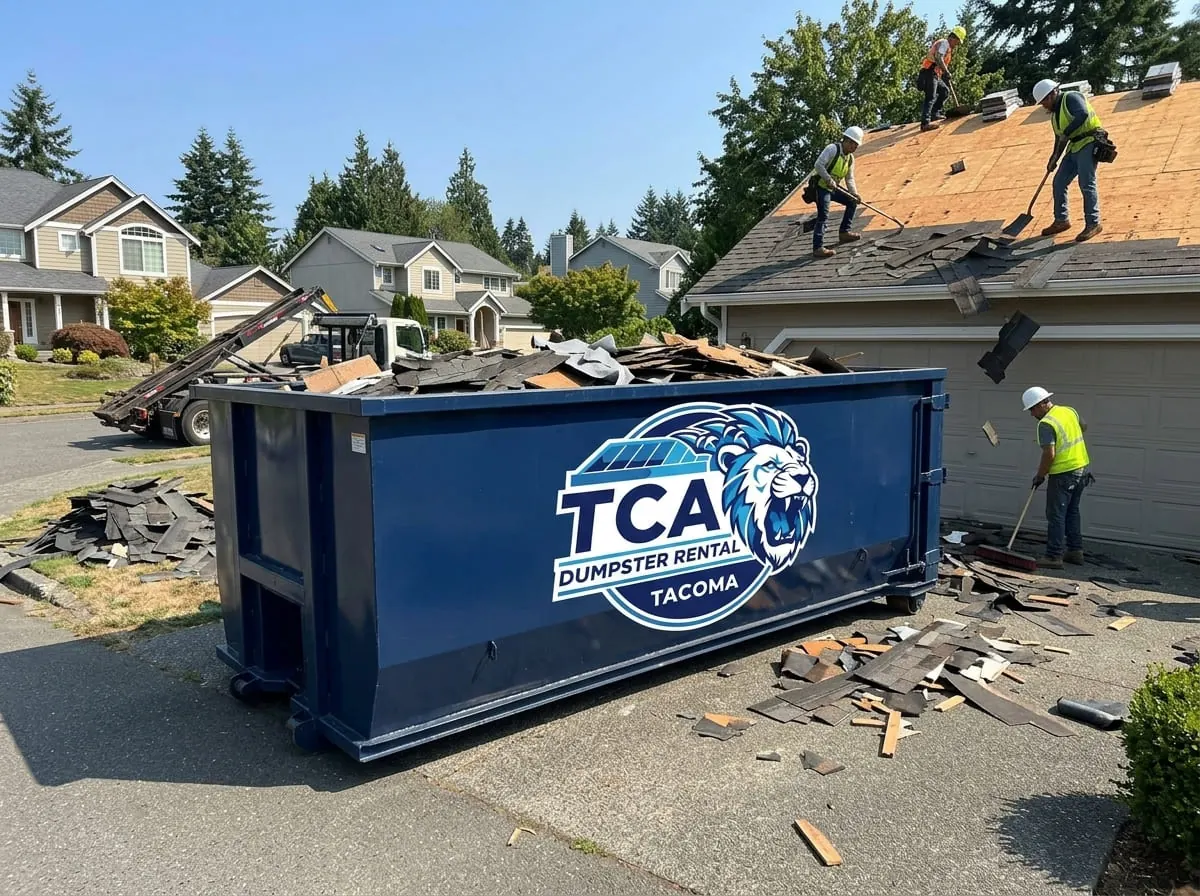
I have been dropping cans on Tacoma roofing jobs since 2012, and the call I get most often in July is some version of "we're doing a roof, send whatever's biggest." That instinct costs people money. Roofing debris is the densest common load we haul. On a tear-off you almost never run out of room in the container — you run out of legal weight, and you run out of it long before the walls are full.
This piece is the numbers side of the job. If you want the reasons a Puget Sound roof dies early, that is covered in our write-up on moss damage and roof replacement in Tacoma. What follows is how to turn a roof into a tonnage figure, and a tonnage figure into the right roofing dumpster sitting in the right spot in the driveway.
The Square Is the Only Unit That Matters
A roofing square is 100 square feet of finished roof surface. Every roofer, supplier and disposal ticket thinks in squares, so that is where the estimate starts. The mistake homeowners make is using the house footprint. A 1,600 square foot ranch does not have 16 squares of roof — it has 16 squares of horizontal projection, and the roof is a slope sitting over it.
Footprint Plus a Pitch Multiplier
Take the footprint including eave overhangs, then multiply by the pitch factor:
- 4/12 — multiply by 1.05
- 6/12 — multiply by 1.12
- 8/12 — multiply by 1.20
- 10/12 — multiply by 1.30
- 12/12 — multiply by 1.41
Then add roughly ten percent for hips, valleys, ridge and starter waste. This is where Tacoma housing stock bites people. The Craftsman and Tudor homes through the North End, Proctor and along North Yakima were built with steep gables — 10/12 and 12/12 are ordinary up there. A 1,400 square foot footprint on a 12/12 is not 14 squares; it is closer to 22 once the multiplier and waste go in. That fifty percent miss is the difference between one pull and two.
If the roofer has already measured, use their square count. They walked it, and their number beats any calculation off a tax record.
What a Square Actually Weighs
Weight per square is where the container decision gets made. Working figures I use when quoting:
- Three-tab asphalt — roughly 220 to 250 lbs per square
- Architectural or laminate asphalt — roughly 350 to 450 lbs per square, and the heavy designer profiles run past that
- Cedar shake — roughly 400 to 600 lbs per square dry, more when it has been soaking up Puget Sound weather for forty years
- Concrete tile — 900 lbs and up per square
- Clay tile — 800 to 1,000 lbs per square, and it shatters into loose volume as it comes off
Notice the spread. Twenty squares of three-tab is about two and a half tons; twenty squares of architectural is four tons or more. Same house, nearly double the ticket. When somebody tells me "twenty squares" and nothing else, I have not learned enough yet.
Layers: The Multiplier Nobody Discloses
Anything built in Tacoma before 1980 should be treated as a multi-layer roof until proven otherwise. Two layers of composition was standard practice for decades because a layover was cheaper than a tear-off. What catches crews out here is the third possibility: composition laid directly over the original cedar shake, common on older Hilltop, Central and South End housing, where the shake underneath often outweighs both layers of asphalt above it.
Two layers of comp roughly doubles your tonnage. Comp over shake can triple it. I have hauled 18-square roofs that produced more weight than 30-square single-layer jobs on the other side of town.
Check before you commit: count courses in cross-section at the rake edge, pull a shingle at the eave, or look at the fascia line behind the gutter. A deck sitting unusually proud of the fascia means something is buried under there.
The Rain Multiplier That Makes This Market Different
This is what contractors moving up from drier markets get wrong in their first Tacoma winter. Tear-off debris is absorbent. Old asphalt, felt and especially weathered cedar take on water like a sponge, and a container left open through a wet October night comes back heavier than what went into it. On saturated shake the difference runs into hundreds of pounds — enough to move a job from comfortably legal to over the line.
Three rules I give every roofing account:
- Tarp the container the moment the crew comes off the roof. Not at the end of the week. Every night, October through May.
- Work the dry window. If you have a three-day break in the forecast, tear off and load inside it rather than stretching a job across a wet weekend with an open can in the driveway.
- Size with headroom in the wet season. Whatever your dry-season number says, assume ten to fifteen percent more weight from November through April and build that into the plan.
Do Not Forget the Decking
When the old cedar comes off, the skip sheathing usually follows. Those 1x4 and 1x6 boards spaced across the rafters were never meant to carry plywood, so a shake-to-composition conversion means a full re-deck. Sheathing runs around 150 lbs per square for half-inch CDX — not catastrophic on the scale, but it eats volume badly because boards and sheets do not nest. Budget the space, not just the tonnage. Wet, rotten decking is heavier again, and on a big re-deck a mid-job swap beats forcing it into one can. Structural work past the roof plane belongs in construction debris planning.
Why the 15 and the 20 Are the Roofing Cans
For shingle work the 15 yard and 20 yard are the right tools almost every time, and the big boxes are the wrong ones.
Roofing debris weighs out before it cubes out. Load a 40 yard with tear-off and you hit legal transport weight when the box is barely a third full — paying for forty yards of steel and using thirteen. Worse, keep pitching past that point and my driver cannot legally take the container off the property. Axle limits are not a suggestion. The truck leaves empty, the crew stops, and somebody climbs in to pull material back out by hand.
The 30 yard earns its place on very large or mixed jobs — a big cedar tear-off with a full re-deck, or a roof running alongside a siding job — but on a straightforward composition roof it is more box than the weight allows. Two 15s, or a 20 with a swap, nearly always beats one oversized can.
Squares to Size: The Working Table
| Roof | Squares | Est. weight | Recommended | Notes |
|---|---|---|---|---|
| Three-tab, single layer | Up to 15 | 1.5–1.9 tons | 15 yard | Garage and small ranch work |
| Three-tab, single layer | 16–30 | 1.9–3.7 tons | 20 yard | Most Tacoma bungalows |
| Architectural, single layer | Up to 15 | 2.6–3.4 tons | 15 yard | Weight-limited, not volume-limited |
| Architectural, single layer | 16–28 | 2.8–6.3 tons | 20 yard | Plan a swap above ~24 squares |
| Two layers of composition | 15–25 | 5.3–9.0 tons | 20 yard + swap | Never one can |
| Cedar shake | 15–25 | 3.0–7.5 tons | 20 yard + swap | Add skip sheathing volume; heavier when wet |
| Comp over original shake | 15–25 | 6.0–12.0 tons | Two or three pulls | Stage it; do not chase one box |
| Concrete or clay tile | Any | Very high | 10 or 15 yard, multiple pulls | Handle as heavy debris |
Weights above are debris estimates, not shipping weights, and they assume dry material. Call the numbers in wet and add to them.
Placement: Where the Can Goes Decides How Fast the Job Runs
Sizing is half the job. Placement is the other half, and roofing crews care about it more than any other trade because they are throwing material, not carrying it.
- Put the can on the tear-off side. A crew pitching straight off the slope into the box moves two or three times faster than one walking bundles across a yard. Tell us the starting elevation when you book and we set it there.
- Give the truck room overhead. The hoist needs clear vertical space well above the box, plus a straight run to back in. Low limbs, service drops and carport eaves stop a delivery cold.
- Respect soft ground. Tacoma lawns in March are saturated, and a loaded can sinks and leaves ruts you repair in June. Driveway is better; we bring boards under the rails, and our notes on driveway protection cover newer asphalt.
- Use the alley. Much of the older Tacoma grid has rear alley access, and an alley drop keeps your driveway usable and the box close to the back slope. Tell us the alley is passable and clear of parked cars.
- Street placement needs a permit. If the can has to sit in the public right-of-way, that is a City of Tacoma permit, arranged before delivery day. See the City of Tacoma site for current right-of-way rules, and our guide to dumpster permits in Tacoma for how the process actually runs.
Before the First Shingle Comes Off: The Pre-1980 Check
Asphalt roofing made before the early 1980s can contain asbestos, and so can the felt and mastic under it. In Washington this is not a judgement call — a survey by a certified inspector is required before most renovation and demolition work, and the Puget Sound Clean Air Agency handles notification here. Read our article on asbestos surveys before scheduling anything on an older house, and check requirements with Puget Sound Clean Air Agency and Washington L&I. Suspect material never goes in a roll-off.
What Rides Along and What Does Not
Fine to load with the shingles: decking and sheathing, felt and synthetic underlayment, drip edge and step flashing, ridge vent, old gutters and downspouts, fascia and trim, pulled skylights and their curbs.
Not in the can: leftover sealant, adhesive and solvent containers, propane bottles off the torch cart, torch-down gear, aerosols, batteries, and anything else on the prohibited list — full detail in what can go in a dumpster in Pierce County. Ask before it goes over the rail; a contaminated load costs more than a phone call.
Swaps, Magnets and the Summer Crunch
On any job past about 25 squares, or any cedar job at all, put the swap in the schedule on day one instead of discovering you need it at 2pm Thursday. Roofing accounts get next-morning delivery and same-week swaps, and a swap we know about gets slotted rather than squeezed.
Run a magnet before the can leaves and again after. Nails migrate: they bounce off the rail, ride out in tarp folds, end up in the strip of lawn beside the driveway. Two passes with a rolling magnet saves the callback about a flat tire.
Last thing: July through September is when every roofer in Pierce County is booked solid, and container supply tightens with it. If your tear-off is in that window, get the can on the calendar when you sign the contract, not the week before. We cover Tacoma, Pierce County and the South Sound, and we hold slots for repeat roofing accounts, but nobody can conjure a truck out of nothing on a Tuesday in August.
Give us the square count, the roof type, the number of layers you expect and the side you are tearing off from, and we will tell you the size, the swap plan and the drop spot in one call. TCA Dumpster Rental Tacoma — call (253) 328-9630, or reach us through the contact page, and we will have the right can in your driveway the morning you need it.
Questions this guide did not answer? Call (253) 328-9630. We would rather spend two minutes on the phone than have you order the wrong container.