Construction
Construction & Renovation Debris in the South Sound: A Contractor's Playbook
C&D debris is its own waste stream with its own rules, rates and weight traps. A Tacoma operator on asbestos compliance, rain weight, material weights and sequencing containers across a build.
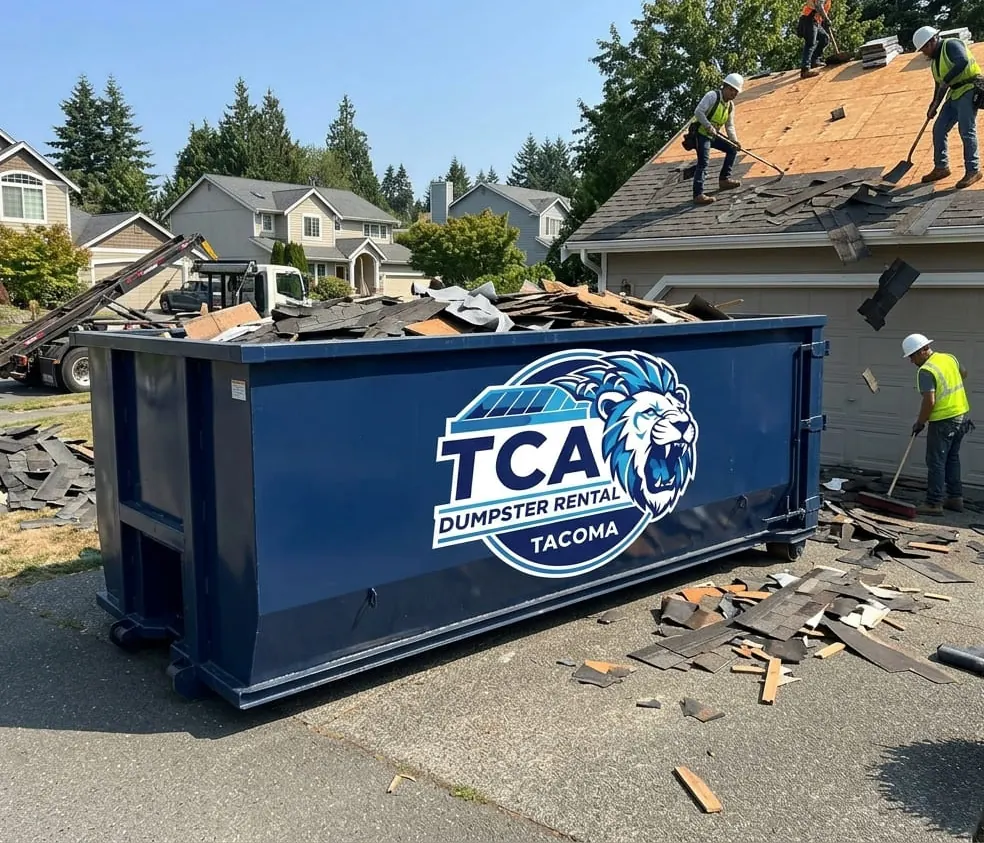
The most expensive mistake I see on a construction job in Pierce County isn't the container size. It's the assumption that debris is debris. A crew books one box for the whole project, fills it with a demo layer of plaster and tile, then keeps stacking framing scrap and cabinet boxes on top of it, and the ticket comes back with an overage charge that eats the disposal line item for the entire job. Nobody did anything wrong, exactly. They just never separated the question of volume from the question of weight, and in this climate those two things drift apart fast.
I've been running roll-offs out of the Dome District since 2012, most of them to contractor accounts. What follows is the stuff we end up explaining on the phone anyway — the compliance gate that will stop your job before it starts, the rain math that turns a compliant load into an overage, and how to sequence boxes so you're not paying to haul air in June and paying to haul water in November.
Construction debris and household garbage are two different products
Construction and demolition debris — C&D — is its own waste stream in Washington, and it goes to facilities permitted to take it, at rates set for it. Municipal solid waste is what comes out of a house: bagged trash, food waste, general household junk. The two get handled at different sites, weighed on different scales, and billed at different per-ton rates. Mixed C&D generally tips cheaper per ton than MSW, but only if the load stays clean.
That last clause is where money leaks. Put a few bags of kitchen trash, a bagged mattress and a half-eaten lunch cooler into an otherwise clean C&D load and the whole box can get reclassified at the gate. You now pay the MSW rate on 3.4 tons of lumber and drywall. The fix costs nothing: tell your crew that the construction container takes building materials and only building materials, and if the job also generates household junk — a tenant left a unit full of furniture, an estate property is being gutted before the remodel — that's a second box or a separate junk removal run. Two clean loads beat one contaminated one nearly every time.
The Washington compliance layer that gates the job
Before a saw comes out on any renovation or demolition that could disturb suspect material, you need an asbestos survey performed by an AHERA-certified building inspector. This is not a federal-jobs-only rule and it is not optional on small remodels. Labor & Industries requires a good faith inspection before work that could disturb asbestos-containing material, and the Puget Sound Clean Air Agency — the asbestos regulator for King, Kitsap, Pierce and Snohomish counties — layers on its own survey, notification and waiting-period requirements. Demolition notifications carry a wait before the structure comes down, whether or not the survey found anything. And in practice, most Pierce County demolition permits will not issue without the survey in hand.
I've watched this freeze jobs. A box sitting loaded in a driveway for three weeks because somebody found 9x9 tile under the linoleum on day two is a bad week for everyone. We wrote the full sequence up separately — read the asbestos survey article before you schedule anything on a pre-1990 structure.
Lead paint is the companion problem
Any structure built before 1978 brings the EPA's Renovation, Repair and Painting rule with it. If you're a paid contractor disturbing painted surfaces in a pre-1978 home or child-occupied facility, you need RRP certification, lead-safe work practices and containment. Half of Tacoma's housing stock predates 1978 by decades — the North Slope, Hilltop, the Proctor bungalows, most of the old Eastside. The EPA's lead program covers the certification path. From a disposal standpoint, RRP debris from a residential job is generally handled as construction debris, but the containment plastic, wash water and chip debris have their own handling expectations, so keep it out of a mixed recycling load.
The Pacific Northwest weight problem
Here's the one nobody plans for. From roughly October through May, an uncovered container is a rain gauge. Tacoma picks up somewhere in the neighborhood of three feet of rain a year and most of it arrives in that window. A 20 yard box with an open top and a flat debris surface can take on hundreds of gallons across a wet week, and water weighs a little over eight pounds a gallon before it soaks into anything.
The soaking is the real problem. Drywall wicks like a sponge, and so do carpet and pad, insulation, cardboard, unfinished lumber, bare soil and yard debris. A load that would have weighed 2.8 tons dry comes across the scale at 4.1, and the tonnage allowance you were quoted on doesn't move because the sky opened up. Tarp the box between work days. It takes two minutes and a couple of bungees, and it is the highest-return two minutes on the site in February. If a serious atmospheric river is coming through, call and move the swap ahead of it rather than behind it.
What materials actually weigh
| Material | Unit | Dry weight | Saturated (Oct–May) |
|---|---|---|---|
| Composition shingles, 3-tab | 1 square (100 sq ft) | 230–250 lb | +15–20% |
| Architectural/laminate shingles | 1 square | 350–430 lb | +15–20% |
| Cedar shake | 1 square | 350–450 lb | up to 600 lb — cedar drinks |
| Broken concrete or asphalt | 1 cubic yard | 3,700–4,000 lb | negligible change |
| Brick, block, stone | 1 cubic yard | 2,800–3,200 lb | negligible change |
| Soil, sod, mixed dirt | 1 cubic yard | ~2,200 lb | 2,800–3,000 lb |
| Drywall, demo scrap | 1 cubic yard | 450–550 lb | can approach double |
| Framing lumber, mixed dimensional | 1 cubic yard | 300–400 lb | +30–50% |
| Carpet and pad | 1 cubic yard | 150–200 lb | 400–500 lb |
| Fiberglass insulation | 1 cubic yard | 40–60 lb | 200 lb+ |
| Brush and yard debris | 1 cubic yard | 250–400 lb | 500–700 lb |
Read down that concrete row and the logic writes itself. Three yards of broken slab is close to six tons. There is no container on our fleet you can legally load full of it. Dense inert material gets a dedicated 10 yard loaded to a marked line, hauled by itself, and priced as heavy debris. Mixing a patio tear-out into a 30 yard of framing scrap is how a routine job produces a four-figure surprise. The cost article covers how tonnage allowances and overage actually get calculated around here.
When the 40 yard earns its keep — and when it's a liability
The 40 yard is a volume tool, not a weight tool. It earns its money on light, bulky, high-cube material: framing offcuts and engineered lumber scrap on a production build, siding tear-off, cabinetry and casework, packaging and crating on a commercial fit-out, ductwork, ceiling grid and tile. On a tenant improvement where six trades are dumping cardboard and blanket wrap for four weeks, one 40 with scheduled swaps beats three 20s and a pile of phone calls. See commercial service for how we set those up.
It becomes a liability in three situations. First, anything dense — you'll hit the weight limit at a third full and pay to move a mostly empty box. Second, tight sites: a 40 wants roughly 22 feet of length plus swing clearance and about 23 feet of overhead for the door, which most infill lots in Tacoma simply don't have. Third, long-duration low-volume work, where a big box just sits and slowly collects other people's garbage.
Sequence containers across the job instead of oversizing
The instinct is to order the biggest box available on day one and be done thinking about it. The better play is matching the container to the phase and swapping. Demo phase: heavy and dirty, so a 15 or 20 yard, plus a separate 10 for any concrete, tile or masonry coming out. Framing and rough-in: bulky and light, which is where the 30 yard or a 40 pays. Finish: low volume, mostly packaging and cutoffs, so a 15 or 20 with a longer rental. Next-day swaps mean you're never paying to store air, and each load lands in the right rate class.
Getting the box on the site — Tacoma-specific
Placement is half the job. The older grid neighborhoods — North Slope, Hilltop, much of Proctor — were platted with rear alleys, and the alley is often the best drop, but plenty are single-lane, unpaved and hemmed in by garages and blackberry. Send a photo before delivery day. Narrow infill lots and skinny driveways may push the box to the street, which means a right-of-way permit from the city; the permit article covers the current process.
Bluff streets above Ruston Way and the Stadium District are steep enough that a loaded truck needs a clean approach and a spotter. Soft ground is a year-round issue in the South Sound and an every-time issue in winter — plywood or steel plate under the wheels and rails keeps a container from sinking into a saturated lawn or cracking a driveway apron, and our drivers carry protection. This piece covers what to lay down and where. Out on the flat industrial corridor through Fife and the tideflats, access is rarely the constraint; the constraint is gate hours and truck traffic on Port roads, so give us a window rather than a time.
Sort what's worth sorting
Every ton you divert is a ton you don't pay a mixed C&D rate on, and some of it pays you back. Scrap metal — ductwork, copper, conduit, appliance carcasses, rebar off a demo — has real value at any Tacoma scrap yard and should never ride in the box. Clean untreated wood and clean cardboard both have outlets. Clean concrete with no rebar, dirt or trash mixed in goes to a crusher for recycled aggregate, and the rate is a fraction of landfill disposal. The Department of Ecology and Pierce County both publish current facility and diversion guidance, and our recycling and disposal rundown lists what actually gets taken locally.
What can't go in the box, no matter how convenient
Washington bans or restricts a short list of things that show up on jobsites constantly. Electronics — monitors, TVs, computers pulled from an office fit-out — go through E-Cycle Washington. Fluorescent tubes and CFLs from a lighting retrofit go through LightRecycle. Leftover architectural paint goes to a PaintCare drop site. Tires, lead-acid batteries and used motor oil all have their own channels. Nothing with free liquids goes in a container, period; if it pours, it doesn't ride. Sealed, dried-out empty paint cans are usually fine, but a half-full five-gallon bucket will get a load rejected. Full prohibited list here.
Book around the dry-season crunch
July through September, every roofer, framer, excavator and remodeler in Pierce County wants a container the same week, because it's the only stretch you can count on the weather. Availability tightens, and same-week becomes optimistic across the whole market. Plan your July and August swaps in June. If your schedule is genuinely fluid, tell us the outside dates and we'll hold a slot rather than guess. Winter work is the opposite — availability is easy, and the weight is the enemy.
Set up an account and stop re-explaining the job
Most of our volume is contractors on standing accounts, and the reason is boring: we already know the crew, the sizes and the sites you work. Swaps get scheduled, not negotiated. Billing goes monthly against the job number instead of a card at every delivery. If you're running more than a couple of projects a year in Tacoma, Fife, Puyallup, Lakewood or anywhere in the South Sound, that's the right arrangement — check our service areas, then call Grant or the dispatch desk at (253) 328-9630 and we'll set it up. Tell us the phase, the material and the access, and we'll tell you the box, the tonnage and the swap schedule before you break ground.
Questions this guide did not answer? Call (253) 328-9630. We would rather spend two minutes on the phone than have you order the wrong container.