Delivery
Delivery Day: Protecting Your Driveway, Lawn and Property in Tacoma
A roll-off container concentrates thousands of pounds onto a few inches of steel. Here is where damage actually happens on delivery day in Tacoma, and the checklist that keeps your driveway intact.
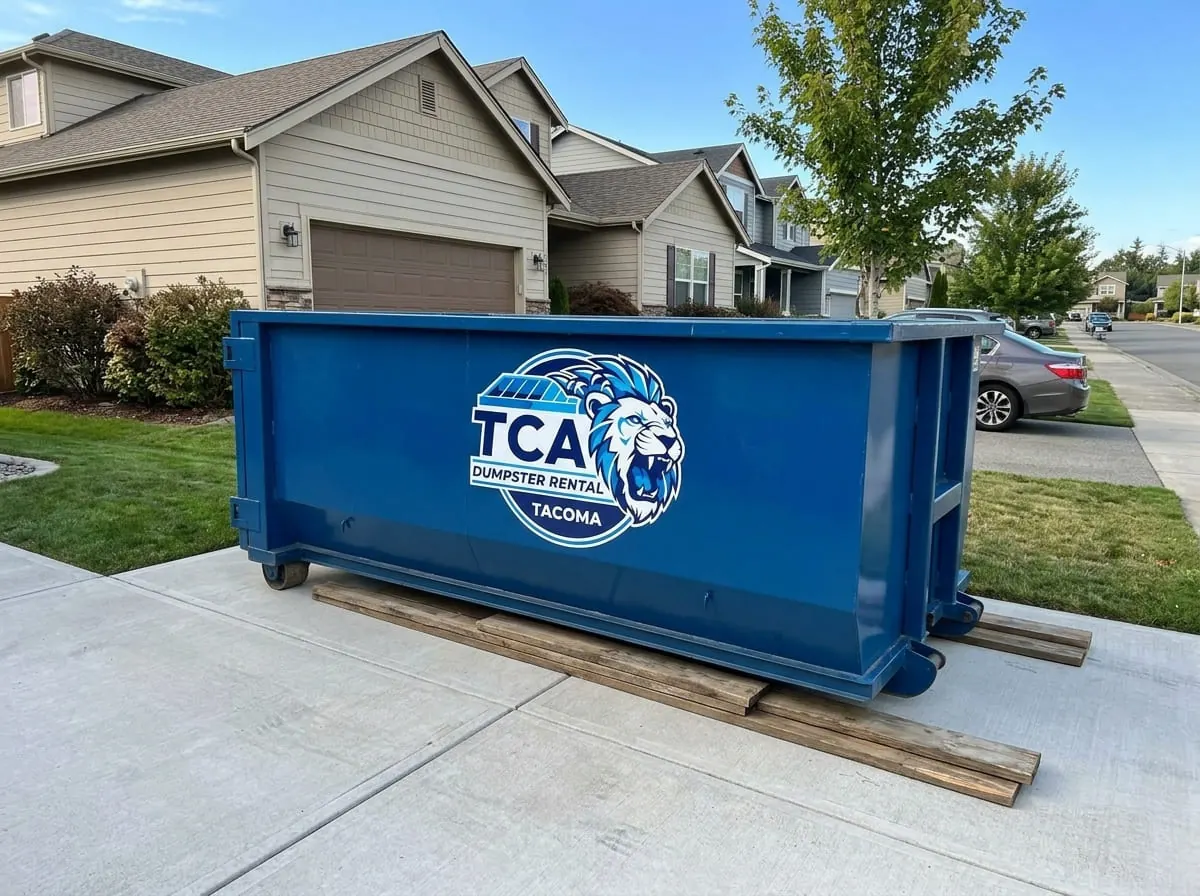
Every delivery I have had go wrong went wrong in the first ninety seconds — not during the week the can sits there, not at pickup, but in the time it takes for the back of that container to come off the rails and touch your ground. I have been running roll-offs in Tacoma since 2012, and the driver usually knows before he sets the parking brake whether this one is going to be clean.
Most homeowners have never watched a roll-off get delivered. Once you know where the load actually goes, the whole list of precautions stops sounding like paperwork and starts sounding like common sense.
What Actually Happens When the Can Comes Off
The truck backs in, the hoist raises the bed to a steep angle, and the container rolls down the rails on four small steel wheels at the rear. That is moment one. Every pound of an empty box — 3,000 to 6,000 depending on whether it is a 10 yard or a 40 yard — rides on four contact patches the size of a coffee cup lid. If the driver lets it run, those wheels skid and scuff. If the surface is soft, they dig.
Moment two is the one people never see coming. As the truck pulls forward and lowers the front, the container settles flat and the load transfers onto the two long steel rails running the length of the box. Empty, fine. Full, not fine. The box does not sit on the ground evenly — it sits on two narrow strips of steel, and everything you threw in is pressing down through them.
The Weights People Do Not Picture
A 20 yard packed with household junk might run 4,000 to 6,000 pounds of debris. The same box with three layers of comp shingle off a Tacoma bungalow hits 8,000 to 10,000 pounds easily. Put clean concrete or dirt in a 10 yard and you are at 8,000 to 10,000 pounds in a box the size of a pickup bed. Add the container's own weight and you have a concentrated point load sitting in one spot for a week.
Then there is the truck: 50,000 pounds or more rolling across your driveway on the way in and the way out. The container is what people worry about. The truck is usually what does the damage.
Protection Boards, and Why They Are Not Optional Here
Every residential delivery we run goes down on protection boards. Not by request, not for an upcharge — standard, on the truck, every day. They are heavy timbers the driver sets under the rear wheels and under the rails, and their entire job is arithmetic: take a load concentrated on a few square inches of steel and spread it across a few square feet of wood.
They also give the wheels something to roll onto instead of scuffing your slab, and they lift the steel clear so nothing sits in standing water and stains. On older concrete they are the difference between a driveway that looks the same in April as it did in March and one with two parallel impressions in it.
Why Puget Sound Is a Different Job
I have talked to operators in Phoenix and Boise who think all this is fussy. Their ground is hard eleven months a year. Ours is not.
Saturated Ground, October Through May
From the first real October rain until sometime in May, the soil here does not fully dry out. A lawn that feels firm underfoot will not hold a truck. Gravel drives are the sneaky one — the rock looks solid, but the subgrade under it is wet clay, and a loaded truck pumps that rock down into the mud and leaves two ruts you will be raking out all summer. Soft shoulders are worse: a driveway edge that was never compacted will shear off under an outside dual and drop the truck sideways.
Moss, and the Concrete Under It
North-facing driveways and shaded pavers here grow a film of moss and algae that turns to grease when wet. Steel wheels on that surface do not roll, they slide, and a sliding container on a slope is genuinely dangerous. If your approach is green, pressure wash it before delivery day. If moss is why you are renting at all, we cover moss damage and roof replacement separately.
Old Concrete, 1920s to 1940s
Half the driveways in the North End, Hilltop and the South End were poured before the war, unreinforced, four inches at best, on whatever base was handy, and they are already cracked into panels. A cracked panel with soft wet soil under it has nothing holding it up, and a point load will tip it. Boards help. Honest conversation helps more — if your slab is spalling, tell us and we will look at the street or the alley instead.
Asphalt in July and August
We get maybe six weeks of real heat, and in that window asphalt goes plastic. Steel rails sink into a warm blacktop drive and leave permanent impressions that do not come out. On hot afternoons we double the boards, and on fresh sealcoat we will suggest a morning delivery while the surface is still cool.
| Surface | Risk | What we do about it |
|---|---|---|
| Newer reinforced concrete, dry | Low | Boards under wheels and rails as standard |
| Pre-1950 unreinforced concrete | High | Extra boards spanning cracks, or move to street or alley placement |
| Asphalt, July and August heat | High | Doubled boards, early morning delivery, smaller box if possible |
| Pavers or stamped concrete | High | Usually decline; recommend street or a flat gravel pad |
| Gravel drive, summer | Moderate | Boards, straight-in approach, no jockeying on the rock |
| Gravel drive, October to May | High | Assess the subgrade on site; often street placement instead |
| Lawn or bare soil, wet season | Very high | We will not drive a loaded truck across it, full stop |
| Moss-covered concrete, any grade | High | Clean it first, or relocate; sliding steel is a safety issue |
| Any noticeable slope | Very high | Find level ground; a loaded box never sits on a grade |
The Hill Problem
Old Town, the streets dropping toward Ruston Way, the North Slope, Stadium District — beautiful blocks, and some of the least dumpster-friendly geography in western Washington. A loaded container on a grade is a hazard nobody should accept: the doors swing under their own weight, the box can creep, and the truck loses traction backing up wet asphalt with ten tons behind it.
On hillside jobs we hunt for any flat spot — a level parking pad, a landing at the top of the drive, a flat section of alley, a legal placement on the cross street. If none exists, the answer is a smaller box swapped more often, or a junk removal crew instead of a container. Refusing a placement is not us being difficult.
What the Truck Physically Needs
Rough numbers, and they surprise people: about 60 feet of straight approach, roughly 10 feet of clear width, and around 23 feet of overhead clearance while the hoist is up. That last one catches everybody. Your carport is not 23 feet tall. Neither is the maple over the driveway or the service drop crossing to the house.
Your Pre-Delivery Checklist
- Move the vehicles. All of them, including whoever came to help. A car in the way turns a fifteen-minute delivery into a phone call.
- Clear the pad. Garbage and recycling toters, the basketball hoop, planters, kids' bikes, the trailer you forgot about.
- Mark the septic tank and drain field. Critical in Graham, Spanaway and rural Pierce County — a truck axle over a tank lid is a five-figure repair. The Washington State Department of Health has guidance on onsite systems.
- Flag irrigation heads, shallow lines and invisible fence. They are all within a few inches of the surface and none of them are visible.
- Flag a recently poured slab. Concrete takes 28 days to reach design strength.
- Warn us about low branches and overhead service drops. Cable, phone and power lines sag more than you think in summer heat.
- Confirm gate widths and any tight pinch point between the house and the fence line.
- If anyone is digging — footings, a new fence, stumps — call 811 first. Washington 811 is free and it is state law.
Alleys on the Old Tacoma Grid
Much of the older city has rear alleys, and they are often the best placement going: off your slab, out of the way, close to the back of the house. A workable alley is paved or well compacted, has no utility pole narrowing the throat, no sagging service drop at truck height, and enough room that neighbors can still get their cars out.
An unworkable alley is unpaved and wet, blocked on garbage day, or too narrow for the truck to swing. Check which day yours gets serviced and do not book delivery that morning. And knock on a couple of doors — a neighbor who knew it was coming is a neighbor who parked elsewhere.
When the Street Is the Right Call
Sometimes the street is simply correct: nothing on the property will hold the weight, the slab is too far gone, or the grade rules out the driveway. That is a legitimate placement, and it comes with a City of Tacoma right-of-way permit. The details are in our piece on dumpster permits in Tacoma. Build in lead time; it is not a same-afternoon thing.
Photos on Arrival
Our drivers photograph the placement area before the box comes off — the slab, the approach, existing cracks, the lawn edge. Forty seconds, and it protects both sides. If a crack was there in March, the photo says so. If we genuinely put it there, the photo says that too, and we own it. Take your own set as well.
Loading Discipline Is Damage Prevention
How you load changes what the container does to your ground. Heavy and flat on the bottom, spread across the floor, not piled at the door end. Break things down so the load settles rather than bridges. Keep everything level with the top rail — an overfilled box cannot be tarped, cannot be legally hauled, and carries its weight high. Keep the barn doors clear. Our guide to what can go in a dumpster in Pierce County covers the rest, and heavy material has its own rules under concrete and heavy debris.
Sizing matters too. People rent one size too small, overfill it, and end up with a box that is over weight and cannot be moved. If you are guessing, read what size dumpster do I need or look at the size chart.
Tarping Is About Weight, Not Tidiness
In a dry state a tarp keeps paper from blowing out. Here it keeps your bill down. An uncovered box sitting open through a wet week takes on hundreds of pounds of rainwater, and drywall, carpet, cardboard and yard debris all soak it up and hold it. You pay by the ton. Cover the load between sessions and you are not paying to haul Puget Sound rainfall to the transfer station.
If Something Does Go Wrong
It is rare, and it does happen. Call the same day, before anything is repaired, and send photos. We come look in person. Thirteen years in the same city means our name is on the side of the truck. A cracked slab or a rutted lawn gets sorted out — arguing about it does neither of us any good.
Grant Sivertsen has run TCA Dumpster Rental Tacoma from 1820 Stewart Street since 2012, serving Tacoma, Pierce County and the South Puget Sound with 10, 15, 20, 30 and 40 yard containers. Before you book, call (253) 328-9630 and describe your driveway — surface, slope, width, what is overhead. Two minutes on the phone prevents most delivery-day problems. You can also check our service areas or send details through our contact form.
Questions this guide did not answer? Call (253) 328-9630. We would rather spend two minutes on the phone than have you order the wrong container.