Waste Guide
What Can (and Can't) Go in a Dumpster in Pierce County
Thirteen years of Tacoma roll-offs distilled into one list: everything accepted in a container, everything banned, and the specific Pierce County destination for each prohibited item.
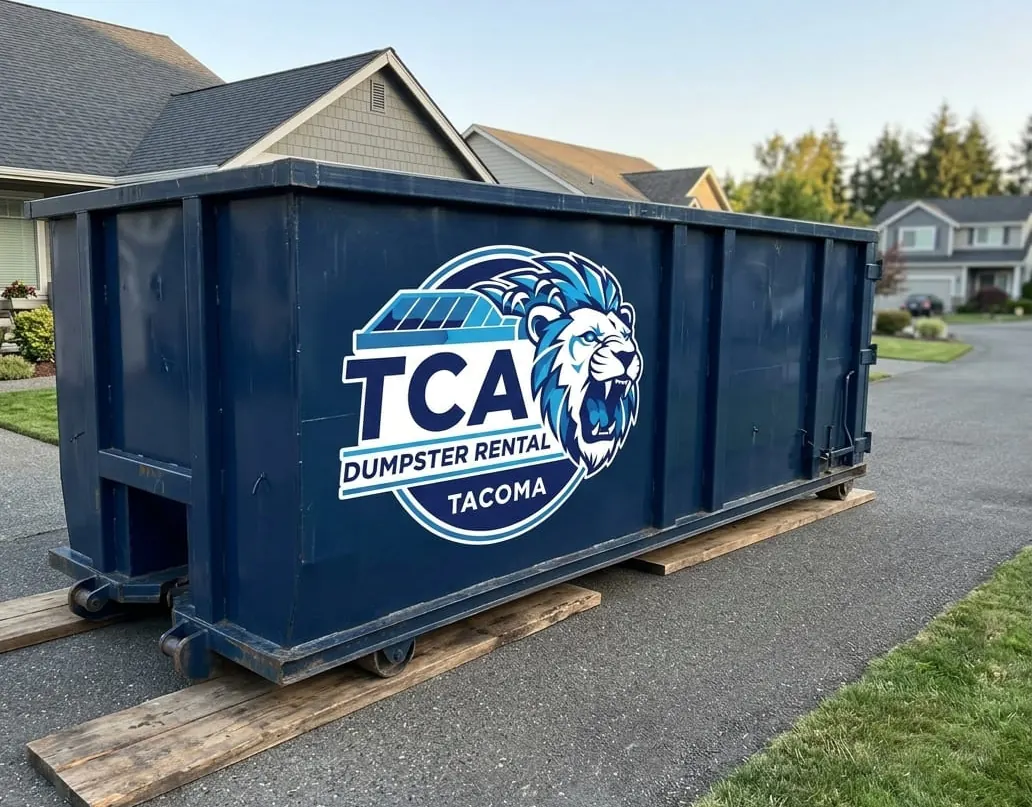
I have been putting roll-off containers on driveways in Tacoma since 2012, and the question that comes up most is not price and not size. It is some version of "can I throw this in?" Usually asked while someone stands over a pile with a dead water heater on top of it and a stack of paint cans off to the side.
The honest answer is that the list of things you can put in a container is enormous, and the list of things you cannot is short but non-negotiable. What most guides get wrong is that they stop at "no." If I tell you the old tube TV in the garage cannot ride along, you still have a TV in the garage. So this guide does the other half of the job: for every prohibited item, where it actually goes in Pierce County.
The accepted list: most of what you are looking at right now
Assume yes on all of the following, in any of our sizes from the 10 yard up to the 40:
- General household junk — boxes, bagged trash, toys, clothing, decor, the entire contents of a hall closet.
- Furniture — couches, recliners, dressers, bed frames, dining sets, desks, office chairs, patio furniture.
- Mattresses and box springs, with a note. They are accepted, but they take up disproportionate volume and some facilities apply a per-unit charge. Tell us how many you have when you book so nothing is a surprise on the invoice.
- Carpet and pad — cut into manageable rolls, tape them, and they load far tighter.
- Drywall and plaster, including lath from older Hilltop and North End homes.
- Dimensional lumber, framing, sheathing, plywood, OSB, trim and clean wood.
- Cabinetry and countertops — laminate, butcher block, tile-over-plywood. Solid stone gets heavy fast; mention it.
- Flooring — vinyl, laminate, engineered wood, hardwood, tile, subfloor.
- Roofing — asphalt composition shingles, felt, ridge cap. Weight is the constraint, not the material. See the tear-off sizing guide or our roofing containers.
- Siding — vinyl, cedar, fiber cement, and the trim that comes off with it.
- Fixtures — toilets, sinks, tubs, vanities, light fixtures, doors, windows, interior railings.
- Non-refrigerant appliances — ranges, dishwashers, washers, dryers, microwaves, water heaters.
- Cardboard and paper — flatten it, it is basically free volume.
That covers the bulk of a remodel, an estate cleanout, a garage purge or a whole-house declutter. If you are unsure of volume, the sizing walkthrough beats guessing.
The prohibited list — and where each item actually goes
Electronics: E-Cycle Washington
Televisions, computer monitors, desktops, laptops, tablets, e-readers and portable DVD players are banned from the container. It is not a preference on our end. CRT glass carries leaded content and flat panels carry mercury backlights and lithium cells, and disposal facilities screen for them at the tipping floor.
Washington built the fix decades ago. E-Cycle Washington takes those devices free at collection sites across the state, funded by manufacturers rather than by you. Note the boundary: keyboards, mice and printers sit outside the program, though several retailers take them at no cost. Call ahead if a screen is badly broken — some sites decline damaged CRTs.
Fluorescent tubes and CFLs: LightRecycle Washington
Four-foot shop tubes and twisty CFLs both contain mercury, and one broken tube contaminates the material around it. LightRecycle Washington runs free drop-off at hardware stores and collection sites statewide. LEDs and incandescents are not a hazard, but keeping all bulbs out is the simpler habit.
Paint, stain and varnish: PaintCare
Leftover architectural paint is the most common thing we find hidden under debris. Latex, oil-based, primer, stain, sealer and varnish all go to PaintCare Washington, which operates free drop-off at participating paint and hardware retailers. Bring it in the original labeled container with the lid on. Aerosol spray paint, solvents and thinners are not PaintCare items — those are household hazardous waste.
Household hazardous waste
Pierce County and the City of Tacoma run free household hazardous waste drop-off for residents. The Tacoma Household Hazardous Waste facility sits at the Recovery and Transfer Center on South Mullen Street, open Friday through Monday with a per-visit limit measured in gallons and pounds. Hidden Valley in Puyallup covers the south and east county. Between them they take cleaners, solvents, pool and yard chemicals, automotive fluids, aerosols and batteries. It is drive-up — you stay in the vehicle and staff unload.
Refrigerant appliances
Refrigerators, freezers, window air conditioners, dehumidifiers and heat pumps hold refrigerant that federal law requires be recovered by a certified technician before scrapping. A shop tag proving evacuation makes the unit acceptable; without it, it stays on the driveway. Handle this before your container arrives.
The rest of the no list
- Tires — tire retailers take them for a small per-tire fee; transfer stations accept them separately from general refuse.
- Lead-acid batteries — auto parts stores take them back, usually with a core credit in your pocket.
- Propane tanks and pressurized cylinders — exchange cages for barbecue bottles, or the household hazardous waste facilities. A sealed cylinder in a compactor is a genuine hazard to the people working the floor.
- Motor oil, antifreeze, transmission and brake fluid — household hazardous waste, or quick-lube shops that accept used oil.
- Pesticides, herbicides and fertilizers — household hazardous waste, no exceptions, even the half-empty jug from 2009.
- Medical and biohazard waste — sharps containers through pharmacy programs; there is no route for this through a roll-off.
- Free liquids of any kind — nothing that pours. Liquid leaks through the container floor onto the driveway and into the storm drain, and that becomes an environmental problem with your address on it.
- Treated timber and creosote railroad ties — old landscape ties and CCA-treated decking need to be declared. Some facilities take them at a premium rate; some refuse them outright. Ask first.
- Contaminated soil — anything from around an old fuel tank or a known spill requires testing and a permitted destination.
Asbestos: the absolute one
Asbestos-containing material cannot go in a container under any circumstances, at any price, in any quantity. Not a corner of it. In Pierce County, buildings older than roughly the mid-1980s routinely contain it in popcorn ceilings, vinyl sheet flooring and its mastic, pipe and duct wrap, siding shingles, joint compound and roofing felt.
Before renovation or demolition you need a survey that satisfies the Puget Sound Clean Air Agency. Owners of single-family homes doing their own remodel may survey their own property; virtually every other situation requires an AHERA-certified building inspector. If friable material is found and coming out, a notification and waiting period apply before work starts. We wrote a full walkthrough of the process in this article, and I would read it before you swing a hammer at anything built before 1990.
Prohibited item to local destination
| Item | Where it goes in Pierce County | Typical cost |
|---|---|---|
| TVs, monitors, computers, laptops, tablets, e-readers | E-Cycle Washington collection sites | Free |
| Fluorescent tubes, CFLs | LightRecycle Washington drop-off | Free |
| Paint, primer, stain, varnish, sealer | PaintCare Washington retail drop-off | Free |
| Solvents, cleaners, aerosols, pool chemicals | Tacoma HHW facility or Hidden Valley, Puyallup | Free for residents |
| Motor oil, antifreeze, automotive fluids | HHW facility or participating oil-change shops | Free to low |
| Pesticides, herbicides, fertilizers | HHW facility | Free for residents |
| Refrigerators, freezers, AC units, dehumidifiers | Certified refrigerant recovery first, then scrap or transfer station | Service fee |
| Tires | Tire retailers or transfer station tire area | Per tire |
| Lead-acid batteries | Auto parts retailers | Free, often a core credit |
| Propane and pressurized cylinders | Exchange cages or HHW facility | Free to low |
| Medical waste and sharps | Pharmacy take-back and sharps programs | Varies |
| Asbestos-containing material | Licensed abatement contractor, PSCAA notification, permitted disposal only | Project-based |
| Contaminated soil | Testing, then a permitted receiving facility | Project-based |
| Treated timber, creosote ties | Declare in advance; facility-dependent | Premium rate |
The grey areas people always ask about
Mattresses. Yes, they go in. Just count them out loud when you book. A king set eats close to a third of a 10 yard container, and per-unit fees at the receiving facility are real.
Appliances. The dividing line is refrigerant, not size. A double oven is fine. A dorm fridge is not, until it is evacuated and tagged.
Yard waste mixed with construction debris. This is the one that quietly costs people money. Clean green — branches, brush, sod, blackberry canes, grass — has its own disposal stream at a lower rate than mixed refuse. The moment you throw two sheets of drywall on top of a load of blackberry, the entire container is mixed waste and prices accordingly. If you have a real volume of vegetation, run it as a dedicated yard waste container and keep the construction material separate. Two clean loads regularly beat one contaminated one.
Concrete, brick, block, asphalt, dirt and rock. Not prohibited — just heavy enough to break equipment and blow past road weight limits. A 20 yard container full of concrete is far over what an axle may legally carry. Heavy material moves in a dedicated low-side clean-fill container, usually a 10, filled to a marked line. Kept clean of wood and trash, it recycles into aggregate at a better rate than landfill.
What actually happens if a prohibited item is in the load
Let me describe the real sequence, because the abstract version does not land. Our driver arrives, walks the container before hooking, and spots the item — say a chest freezer buried at the back. He cannot legally haul it. So the load stays, you get a call, and the day is gone. That is the good outcome.
The bad outcome is that nobody spots it and it reaches the tipping floor. Facility spotters catch it, the load is flagged, and now you are looking at a rejected-load charge, a sort or special handling fee, a return trip fee, and with a punctured chemical container, cleanup billing. I have seen one overlooked five-gallon bucket of deck stain turn a routine job into a bad afternoon for everyone. None of that is a company nickeling you — those charges come straight from the facility at cost. Our full fee breakdown lives on the pricing page.
The prevention is thirty seconds long: before you call for pickup, walk the container once and look at what is on top and what went in first.
Where your material actually ends up
Loads out of Tacoma generally route through the Tacoma Recovery and Transfer Center on South Mullen Street, where recoverable material is pulled and the balance consolidated. Most residual waste then travels to the LRI landfill in Graham, off 304th Street — a permitted regional facility, not a hole in the woods. Clean wood, metal, cardboard and clean concrete divert out before that point wherever load composition allows. Sorting on your driveway is what makes diversion possible; a jumbled container mostly cannot be pulled apart at the facility. More on local streams in our Pierce County disposal guide.
One honest caveat
Stewardship programs, facility hours, accepted-item lists and fees change. E-Cycle, LightRecycle, PaintCare and the county hazardous waste facilities all revise their rules periodically, and a site that took something last spring may not this fall. Confirm current details with the agency you are heading to, and call ahead if you are driving in from Gig Harbor or Eatonville. Our FAQ covers the container side.
Talk it through before you load
Thirteen years in, I would rather spend four minutes on the phone with you than have a driver leave a full container sitting on your driveway. Describe your pile, name anything you are unsure about, and we will tell you straight whether it rides or where it goes instead. Call TCA Dumpster Rental Tacoma at (253) 328-9630, or send the details and we will size it, price it and deliver. We run 10 through 40 yard containers across Tacoma, Pierce County and the South Puget Sound.
Questions this guide did not answer? Call (253) 328-9630. We would rather spend two minutes on the phone than have you order the wrong container.